Welcome

Welcome to my blog I hope that you enjoy your time here.

Monday, September 20, 2010

Beginnings


                                         BEGINNINGS

            I was born on January first, in a Washington, DC hospital, in the year of 1942. I was not the first child of the year but I was the first child of my parents, Worden Calhoun McDonald and Florence Plotnick. I was to learn many decades later that they were not legally married, a fact confirmed by the records kept by the FBI on my parents’ lives. My mother once growled at me, “We planned every child,” and I assumed that was the case, but my father confessed one day after I was grown that his mother had come to visit and see the new one-and-a-half-year-old grandbaby and so they “got married then.”

    All that aside, I was loved and my parents stayed married and were together almost every day for the rest of their lives. My mother lived into her seventies and my father into his eighties, and they died a year apart, both from cancer.

    Less than three years after my birth, my sister Nancy Victoria was born. These were troubled times for Eastern European emigrants and socialists, and my parents followed my mother’s parents’ lead and moved to Los Angeles County where my grandfather Harry Plotnick had a dry cleaning and tailor shop. My dad put in for a transfer from his Bell Telephone Company job and got work in the L.A. office. We settled in Culver City where I went to kindergarten and got my first guitar lessons.

    The family took the train across the country and my dad proudly told the story of how I would order breakfast of “sausage and eggs” in the train dining car. He was probably remembering when he “rode the rails” during the Great Depression as a hobo either on the top of the cars or in a box car with many, many other hungry unemployed hobos.
    After our stay of not quite two years in Culver City, my folks found a house to buy in the sleepy little San Gabriel Valley town of El Monte, where I remained until I enlisted in the Navy at the age of 17, after graduation from Arroyo High School.
    As a full-grown man after my father’s death, I went with my cousin Bob McDonald to the little Oklahoma town of Sallisaw, where my father had grown up. I realized how similar El Monte and Sallisaw were. Little wonder that my father had chosen to settle in that place on a quarter-acre lot with a two-story house and immediately planted fruit trees and a vegetable garden and acquired chickens, rabbits, and even several horses. He was reliving some aspect of his childhood on McDonald Hill in Sallisaw, growing up on Old McDonald’s Farm.
    In El Monte, when I was ten, my brother Billy, William Patton McDonald, was born, and it was the three children and Mom and Dad for the rest of our lives.
    At the age of ten I was taken to a music store and asked to blow into several instruments, and it was decided I should play the trombone in the elementary school orchestra. Thus began my musical career. 

                    We often saw my grandparents, my mother’s parents Harry and Bessie, and Bessie’s sister Aunt Rose and Uncle Louie Zelman. The two sisters had come over together from Russia, got married on the East Coast, and moved to the West Coast at about the same time. My mother said they always wanted to be together. My grandfather Harry, I am told, was a Zionist and my grandmother Bessie a Communist. They fought over politics their whole life. Bessie had red hair and the conservative Plotnicks of Richmond, Virginia called her “Bessie the Red.”

    A family story was that sometimes customers would ask Harry if he had a wife and he would reply, “Oye, do I have a wife?!” in typical Jewish joke style with his Russian accent. Bessie took my mother to Communist Party meetings in Washington, DC from a very early age, and both women seemed to love meetings and socialism their whole lives. My mother late in her life became a political driving force in our hometown of Berkeley, California. She was the most elected politician ever, they say, holding office of Rent Control Board, City Council, and City Auditor. My father hated meetings.
    On the other side of the family, my grandmother Emma had happily married a Presbyterian minister, James Angus McDonald, who had four children from a previous marriage. She was young, and a friend said at the time “Poor Emma has had her last peaceful day.” She went on to have five children with my grandfather, two of whom died. She played the piano in the church and held the farm and the family together for decades with a smile and loving attitude. She always lived a life of Christian grace.

    After the Depression and early death of my grandfather, Emma moved to Fullerton, California and lived with my Aunt Beatrice, my father’s older sister, and her husband Ralph. She passed away at 93. She always stayed on the sunny side of life and my father was the youngest and her baby. Both grandmothers, besides being very different politically and socially, were a strong positive force.
               But that was the end of family in my life for some reason I have never understood. Probably it was politics. But even my father’s brother Angus told my cousin Henry to “go around Oklahoma, it is not worth seeing.” I don’t know about the estrangement of the Plotnicks but my mom always said, “We don’t believe blood is thicker than water.”

    It is a fact that there were terrible wars in Oklahoma over communism. It’s something we don’t hear about in books and school. But people shot each other over politics. And of course my mother married a non-Jewish person, which was reason to disown someone in an Orthodox family.
    Although we were loved and well taken care of as children, ours was not a very affectionate home. The Great Depression, the Russian and German pogroms, the Holocaust, World War II, the struggle for equal rights for African Americans, the struggle for the right to have unions for working people, and later the Un-American Communist witch hunts of the 50s took their toll on Mom and Dad. There was little to none of hugging and kissing and open affection and a kind of starkness and spareness to our lives as far as the home life was concerned.


My father turned our yard into a beautiful place of greenery. He planted fruit trees that bloomed and bore fruit and corn and other vegetables and we had dogs and rabbits and chickens and a horse and a donkey once and goats and pigs. He taught me how to be a farmer on our little piece of property there in L.A. County, and we even broke a horse together – that is, to teach a horse how to be comfortable with a rider on it and obey commands of turn left, turn right, and stop and go and stuff.


    Our town had a mostly dry river bed running through it. Perhaps it was the San Gabriel River? I would ride Rebel, the horse my dad and I had broken, in the river bed, bareback at times (without a saddle). I was so small that if I fell off I would have to find a rock or something to climb up on to get back on him. He was a gelding, “cut proud” as my father used to say. A gelding is a male horse that has been castrated. “Cut proud”: I guess meant that he still had spirit. He was a pinto, brown and white. I have an old family shot of Rebel with his front feet up on a wooden platform, doing a kind of trick, with my sister on his back.
    I would gallop him through the dry river bed with my BB gun. It was a Red Ryder BB rifle model. My dad had taught me that if you whistled, a running rabbit would stop and listen and then you could get a “bead,” or take aim at it and shoot. That is what I did. I don’t remember ever hitting one. 
   

        There were lots of adventures there in that river bed. It was large. It had a rock crusher in it – a big bunch of machinery that crushed up rocks into gravel. It also had a “skeet shoot.” A place that fired clay Frisbee-like things up into the air and people shot them with rifles out of the air to practice shooting. Funny thing is, I have no memory of ever seeing anyone using the rock crusher of the “skeet shoot.” But I would pick up the broken skeets as souvenirs. I don’t remember anyone else riding with me in the river bed. I would pretend to be a cowboy and go up and down grades of sand with that Southern California landscape of brush and stuff. 
    Dad used to sometimes take Rebel, or other horses we sometimes had, and make them run in the sand. It wore them out, he said, so that they were less inclined to misbehave. A horse that has too much energy or wants to misbehave can be a problem. It can throw you off by bucking or shying, moving suddenly to the side or even bite you or kick you. My dad said that a hand-fed colt that is treated like a pet can be a real pest later in life as it will just come into the house like a dog or cat. I like that image.
   
            After Dad and I broke Rebel to the saddle he was very gentle but he was young and full of energy. One day as I was riding around the backyard bareback, he took off in a canter in that small space and I slid off his back and fell in front of him lying on my back. I remember looking up into those big round intelligent eyes and seeing that enormous hoof coming down on my face. Our eyes made contact and he lifted his hoof and I was not even scratched. Horses are amazing animals.

    Dad was good at understanding the boundaries of animals with people but I don’t think he understood the boundaries of normal relationships between people. He said he always go along better with animals than people. My dad always said whenever I was thrown off a horse, “You have to get back on the horse if it throws you, otherwise the horse will think you are afraid of it and you will think you are afraid.”

    In his autobiography An Old Guy Who Feels Good, he said he discovered early on when he was a traveling cowboy that if he could back a horse into a corner and get a good look into its eyes, he and the horse could come to an agreement and could work together. 
    I think that his advice about getting back on the horse is good in moderation. Both he and I seemed to be a bit obsessive-compulsive about this. I remember in the 60s Barry Melton and I would take LSD together and sit with the Timothy Leary Tibetan Book of the Dead and light candles and read and read and read, trying to understand the bardo thing. First bardo, second bardo, and lining up your chakras and all that. We would start laughing because we just could not get what the heck he was talking about. Maybe he was talking about nothing, I don’t know, but we did that many times. Too many times. It started to be nonsense.
   

        I got into reading the I Ching, Chinese Book of Changes, in the 60s and the Tarot Cards. I did the same thing with them. I would read the cards many times in a row and toss the coins over and over until the oracle, like a good sponsor, would get sick of my behavior and tell me to go do something else and stop thinking about myself and my future.

             I remember that when the rains would come to El Monte, the river bed would fill with water and we would take inner tubes and float down the river. It was great fun, one of the few things I did with other children. Us guys would start somewhere and float as long as we could without having to hike back too far. I also remember having BB gun pretend-war fights in the river bed with other kids.

    Things changed when I was twelve years old. That was the year that the California Un- American Activities Committee served my father with a subpoena to appear before it and testify as to his knowledge of communist activities. He was working for the Los Angeles Bell Telephone Company and no longer a member of the Communist Party. My parents were in the Progressive Party then. They tried to serve my mother with papers but never did. My sister Nancy tells me that Mom sent her to the door to tell the FBI guys that she was not home.

    But my father testified. He took the Fifth Amendment. He refused to tell them anything on grounds that it might incriminate him. He was then given the choice of getting fired from his job or quitting. He quit. He was very close to having a vested pension plan. He had worked nineteen years for the telephone company. He got nothing. It makes sense that my father would quit. He was proud. He was a strong, silent, farm-boy type – an easy type to take advantage of. He would not argue and defend himself with a lawyer and stuff like a city person might have done. It was hard after that. He said one day that he remembered that when he would go into a store as an employee of the telephone company the ladies “would treat you with such respect.”  Well, they sure did not treat him as a suspected communist enemy of the country with respect. And we began a downward social and financial decline.



Chelsea Hotel


                                                        CHELSEA HOTEL


      I started staying in the Chelsea Hotel in NYC because the Vanguard Record Company’s studio was on 23rd Street and so was the Chelsea Hotel. I had no experience at all with New York City before 1967 when Country Joe and The Fish, the electric version, began to record albums in the Vanguard studio. Well perhaps I did, although the first album was recorded in Berkeley at Bob DeSousa’s studio. Soon afterwards we did get a job playing at the Cafe Au Go Go in the Village, in NYC, and perhaps that was the first time I stayed at the Chelsea. But no matter, it became pretty much the hotel of choice for over several decades for me playing with various configurations musically of rock bands, duets, and solo.

           The man who wrote “Tubby The Tuba” a story that involved a talking tuba that was quite popular when I was a kid, lived in the Chelsea. His daughter used to hang out with my bass player Peter Albin, during the All Star Band period. We always stayed at the Chelsea. My second wife and mother of my daughter Seven Anne, Robin Menken, threw some really dramatic scenes at the Chelsea. She had come on tour with me when we were boy friend, girl friend and we fought so much at the Chelsea that I sent her home. She was in the lobby crying and crying with our manager Ed Denson and her film magazine collection. As they waited for the cab to take her away to the airport. That of course was not the last I saw of her as we got married and the marriage is featured on the whole album cover of Country Joe and The Fish’s TOGETHER album.

    There was a period of time in the 1970s that Barry Melton and I toured as an acoustic duo. We were billed as Country Joe and The Fish sometimes. Though that always seemed to me to be stretching the truth, Barry seemed quite pleased with it as he had taken to calling himself Barry “The Fish” Melton. But never mind that bullocks.

    I remember Barry and I sharing a room at the Chelsea. I had been working out with free weights and also running or jogging you might say. I was following Franco Columbu’s weight exercise program, something that I still do today. I was in very good shape. I convinced Barry that we should take weights with us on the road. I had a special box with barbells in them. It seems so totally stupid now but I have always been anxious about leaving my routine home and going on the road, and so this seemed a way to take a bit of my home routine with me. We of course did not have roadies to carry the stuff around so we had to.

    I remember one time getting onto a small plane to take us to Uncertain, Texas for a gig for some dope dealers out in the boonies and the look on the pilot’s face as he lifted up this very heavy metal box and me telling him it had our weights in it. Anyway Barry was in not so good shape and I convinced him to try an exercise routine. He had a bad leg from a motorcycle accident years before Country Joe and The Fish so running was not possible, but the free-weight thing just might work.

    There in that room I worked my routine and ran the streets of NYC. I have some nice pictures that a guy named Sidney took of me back then running and looking very fit....nice. Barry had been game up to one day in the Chelsea when he was lying on his back doing Franco Columbu’s arm extensions with the dumb bells and smacked himself in the forehead with the weight. He lost interest after that. So he would go out and do stuff and I would stay and work out. This was the reverse of what we sometimes did later when he was studying for the bar, to become a lawyer, with a mail order study course, and I would go out and party and he would stay back at the hotel and study and say, “McDonald, you live on the material plane.”

    So while he was out one day I decided to shave my body like the guys in the Pumping Iron book and film. So I did. It took a bit of time and I washed all that hair down the drain of the Chelsea Hotel shower. It sure does work though on your body like when you shave off facial hair you always look younger. When Barry came back and he saw me in my shorts without my shirt on he said, “You know Joe, this working out has you looking years younger.”

    Tucky Bailey played flute and alto sax with the All Star Band. Before joining the band she had played background music for Toad the Mime who performed on the street in Ghirardelli Square in San Francisco. She had never been to NYC until we got some work there. It was the fashion to go to Max’s Kansas City and eat at the restaurant on the ground floor and see a show, or play our show in the club upstairs. They had chickpeas and a great salad with blue cheese dressing.

    The night I remember the three women in the band, Tucky Bailey, Anna Rizzo the drummer, and Dorothy Moskowitz the piano player, went upstairs to see Tim Hardin play. Tim had a problem with drugs and seemed very, very stoned that night. He was wearing what seemed to be a kimono and had a small group backing him. He seemed oblivious to the audience. The ladies got very drunk and kept yelling shit at Tim. It was pretty embarrassing to me but I could not stop them.

    At the end of the night we went back to the Chelsea Hotel and Tucky and I got into the elevator. She then threw up. I told her, “Wow Tucky, your first day in NYC and you ate at Max’s Kansas City, got drunk and yelled at Tim Hardin, and threw up in the Chelsea Hotel. You’ve had quite an introduction to New York City.

Sunday, September 19, 2010

Live performances

Country Joe's Place

_____________________

I have started to work on an autobiography and will occasionally post some installments.
LIVE PERFORMANCE
       Live performance is always a challenge and you never know what will happen. The audience often does much more than just applaud or boo.

      Of course me and the Country Joe and The Fish band were famous for both the Fish Cheer and the Fuck Cheer. I sometimes worried what would happen when I yelled "Gimme an F!" and the audience did nothing ... but that has not happened yet. But what did happen in New York City one night was worse. Barry Melton had written a song called New York City Goodbye which was a very definite put down of the city and he decided to put the song in our set at the Fillmore East which was the place to play rock and roll in New York City. The response was cool to say the least. At the end of our set it came time to sing "I Feel Like I’m Fixing To Die Rag" and we opened with the fuck cheer. We yelled out the letters and the audience responded but when it came time for the "What’s that spell?" part a guy in the front row yelled out after "What’s that spell" "FUCK YOU!"

     Yikes! That was a shock and a bummer and, well, a show-stopper, but we could not stop, so we did it again, "What’s that spell?" and he answered again with "Fuck you!". Boy that was not good. We did it again, "What’s that spell?" and he answered very loud "Fuck you!" I looked at Barry Melton and he looked at me and then he looked down at the guy and said, "Fuck you". We played the song and left the stage and did not get an encore.

        Jane Fonda’s anti-Vietnam War show called FTA Show or Free The Army or as the GI’s used to say, Fuck The Army, with Donald Sutherland, Ben Vereen and others involved my wife Robin Menken as a writer. Jane requested that I get involved in their plan to bring entertainment to military personnel by performing in GI coffee houses near military bases. The GI coffee houses were set up by various antiwar groups so that military personnel could come and hang out and find out different points of view on the war from those that they heard on the base and from the government. The show was a variety show with comedy and dramatic skits and satire about the government and the war.

      I don’t think Jane had any live performance experience before the FTA Shows. I am pretty sure all her performance experience was in front of a TV camera. After a few shows Jane asked me "How do you do it, Joe?" She was asking how one gets a good response from the audience under the conditions we were working in. The conditions were less than first class but pretty regular for a traveling musician, coffee houses mostly. She had only done movie work up to that point and found it confusing.
I tried to explain to her that we could not do any retakes and just had to go with it how ever it turned out. This demanded a lot of flexibility as the audience had a tendency to get involved in the act.

      You just never knew how this would manifest itself, sometimes good sometimes bad. For instance when I was performing solo at the Fillmore East once. I had done most of my set without any unusual things happening . I had just released an album of Woody Guthrie songs so I sang his song about the Columbia River, "Roll On Columbia." The song is in waltz time, one of my favorite time signatures. But this time the audience began to clap along. This had only happened on other time to me and that was in Vienna Austria, the waltz capitol of the world, and there they clapped in 3/4 time to every song, even if it was not in waltz time, which most of my songs were not.

       But at the Fillmore that night they began a 1, 2, 3, clap with nothing on the 1, and then a clap on the 3 and 4. This sounded like, silence, clap, clap, silence, clap, clap, you get the idea. Very unusual but it worked fine and was good clean fun. But towards the end of the song one of my guitar strings broke. I decided to stop and change the string but told the audience that they could continue clapping, so they did. I went off stage, got a new string, came back and while sitting on my stool and listening to them clap I changed the string. I tuned up my guitar and went right back into the song, sang a few verses and choruses to their clapping and ended it.

       The audience gave me a round of applause followed by silence and I contemplated what do do next. Then of a sudden I heard a single person start the clapping thing again and soon the entire audience was clapping the waltz time thing again and looking at me with smiles on their faces! It was obvious that they were not about to stop so I did the whole song again much to their delight and my surprise. The ending was followed by huge applause and another silence. This silence was a bit tense as we stared at each other in the silence and wondered what would happen. And then one by one they started the clapping again! I played "Roll On Columbia" three times that night.


       Woodstock was not the only huge festival to happen in the late 60s and early 70s. I had the honor to also play solo at both the Bickershaw Festival and the Bath Festival in England. Both festivals lasted several days, had lots of head line acts, hundreds of thousands of people and also rain and mud. I started to think brought the rain with me.
At Bickershaw there was a steady drizzle during my set. At the end I closed with the "Fish Cheer" and "Fixing To Die Rag" just like at Woodstock and was called back for an encore. Being at a loss as to what to do asked the audience what they wanted to hear and they yelled back almost in unison "Do it again," so I did. I left the stage and to my surprise was called back for a second encore. I really did not know how to follow two "Fixing To Die Rags" and shared my thoughts with the audience, but no problem they yelled back "Do it again!", so I did! It was great fun. Almost everyone who speaks English loves to yell fuck in a large group and people of a certain age love to sing that song, perhaps "Fixing To Die Rag" is one of the only fun things about the Vietnam War.

      Speaking of the Vietnam War, about 1990 I performed for the group Veterans For Peace, at their convention, in a hotel in San Francisco. A man named Phil Butler came up to me and asked if we could talk. I said sure. He told me he had spent about seven years as a prisoner of war in the famous secret Communist prison camp called Hanoi Hilton, during the Vietnam War. He had been a fighter pilot and was shot down, as most of the prisoners there were. He told me that the only entertainment the prisoners had was the Communist propaganda radio show with the DJ Hanoi Hanna. Hanoi Hanna played American pop and rock music and gave commentaries designed to depress the Americans and get the prisoners to confess to "war crimes" and turn against the American war effort and government.

      Every now and then Hanoi Hanna would play "I Feel Like I’m FIxing To Die Rag." He told me that it was always a morale booster for the prisoners in the compound and that some even hummed and sang along. The prison camp officials could never understand why this song with it’s refrain "Whoopee we’re all gonna die" could be a morale booster. They were of course Vietnamese and many had been educated in Paris and learned English and about American democracy there. But American humor is not French humor -- it is something special the world over and a one of our great strengths. I have heard so many stories about this song from American soldiers who fought in Vietnam that always astound me but this story was the farthest out. Then Phil Butler, knowing that I was going to sing the song that day at the convention said to me, "I am just glad that I lived to hear you sing it in person." Upon which we both began crying and hugged each other.

       Back to the Bickershaw Festival in the rain. I was amazed that I managed to hold that huge audiences attention when I sang a Robert W. Service poem I put to music, from the album War War War, titled "Jean Desprez." The ballad is almost ten minutes long. The English of course have strong feelings about the World Wars and that song is about World War I. There are still parts of England to this day that remain destroyed by WW II bombs. They love Robert W. Service’s story of the French resistance fighter; the Prussian Captain and the French peasant boy, with its dramatic surprise ending. I can still bring a picture to my mind of those audience members huddled under their tarps, tents and umbrellas listening intently to every word of that song and cheering at the end. A short time later I sang the song to another rain drenched English audience at the Bath Festival* under those same conditions and got the same reaction.

     Thinking of the Bath Festival brings several memories to my mind. First I remember traveling to the Festival in a limousine with my road manager, Bill Belmont and my wife Robin Menken and our young daughter Seven Anne. I know this sound fabulous to all people who have dreamed of riding in a limousine. The trip out was fine but on the way back the limo broke down on the motor way and we sat at the side of the road for three hours in the cold weather waiting for the people to come and repair it.

      When the Woodstock Music Festival movie showed for the first time in New York City the Country Joe and The Fish band were playing a concert a few hours away. The showing of the movie was early enough that we could just see it and then drive to the show. Someone provided a limousine for us to ride to the gig in. We were staying in New York City so it was no big deal to go to the opening and then drive to the gig. Of course we were excited about this. We saw the movie and then exited the theater to our limo. We had all come to see the movie, band members and road crew. There was three roadies and five band members and our manager ED Denson. We were many more people that could comfortably get into that car. I remember a horrible three hour drive that had people even sitting on the floor and we finally got to the gig in a terrible mood but happy to get out of that limo for sure and hesitant to take another offer of a free limo ride.

      I did not have such a great success with the Jean Desprez song years later singing at an industrial college outside of London. The stage was just a riser about six inches off the ground and the audience of students sat on the floor in front of me. There were about 300 people there. Behind the audience there was a door leading from the hall to a corridor and another open door leading into a bar. I performed for about 45 minutes and everything was going fine. I decided to sing the long Jean Desprez ballad and started. About two or three minutes into the song I saw a young man leave the bar and start walking into the hall where the audience was and I was singing. He was looking right in my direction and I don’t know why but I thought to myself, "Here comes trouble"!

        With the careful wobbly steps of a drunk person he made his was through the crowd, careful not to step on his fellow students. With a steady determined pace and his eye on me he made his way towards the stage. The song ran through its many dramatic verses building to the grand finale as he grew closer and closer to the stage and me. There was nothing I could do to stop him or the song. It has about fifteen verses and at the twelfth verse he reached the stage and at the thirteenth verse he stood my my side and bent over and asked very nicely:

"Excuse me but who are you?!"

      My brain was blown. I knew he would not go away nor would he stop asking me this question. I stopped playing and just looked at him in disbelief. We stared at each other. He asked me again "Who are you?" The local promoter was standing off to the side of the stage and now noticed what was happening and came over and led the young man away, hopefully explaining to him who I was. The audience stared at me trying to figure out what had happened. I returned to task at hand and not wanting to start the song over again decided to just sing the last verse, and that is what I did. Of course in the elapsed time most of the audience had forgotten what the song was about and the dramatic effect of course was severely lessened. But the show must go on!


      Yes, God bless the audience, you just never know what they are going to do, but without them you are out of a job.

       In the mid 1970s riding on the popularity of my Fantasy Records album Paradise with an Ocean View I got a job opening some shows with the original Santana band. This was great as I always thought they were one of the finest bands to come out of the 60s. We were playing Denver, Colorado venue called Mammoth Gardens. During the first part of my set a huge crowd outside that was refused admittance due to the place being full already pushed open the doors and crowded their way in. This created a joyous mood in the already happy audience.

       I decided to sing the Jean Desprez song, a bad choice. About half way through the song noticed that the people pressed up against the front of the stage were smoking huge marijuana cigarettes and blowing the smoke up towards me. The top of the stage was about the height of their heads.

         Once again, as I watched the cloud of smoke rise I thought, "Here comes trouble." Working my way through the verses of the song to its dramatic ending I watched the cloud of pot smoke rise from my feet, to my knees, to my waist, then to my chest and at last to my face. I then became totally disoriented as I tried to sing and as I sang inhaled pot smoke. I no longer had any idea where I was in the song or even what the song was. I stopped singing, looked down and the people blowing smoke at me and the audience cheered their victory. Once again they had worked their way into the act.

       It was during that show that I got perhaps the best career advice I have ever received. I came off stage and Carlos Santana was standing in the hall outside the dressing rooms. The Santana Band was going on after me. the crowd was cheering and I was sweating and starting to come down from the excitement and tension of doing my set. We said hello and then I said to Carlos, "It is so weird doing this solo act!"
Then he said, "It is a blessing Joe. There are not many people who can do it and you are one of them." Thank you, Carlos, that advice has helped me many times over the years.


       Touring the country of West Germany in the 1970s I always had lots of American military personnel in the audience. They were of course lonesome for home and excited to see American rock and roll bands. Once I was playing a night club with my All Star Band about 1972. The place was packed so full that no one could really move, including us. We were stuck up on stage when the sound system broke down and we had nowhere to go. The dressing room was not accessible and we just had to wait up there for them to fix it. It was really hot and noisy in the place. I kept hearing a guy yelling, "I love you Country Joe! California! Woodstock!" over and over. It was really getting on my nerves.

       I looked around and could see they guy, this young soldier right there in front of me in the crowd. Now I had been in the military myself and knew what it was like to be along way from home and drunk in a night club but it was hot and I was mad about the PA not working and not being able to play and trapped on stage and this guy yelling, "I love you Country Joe! California! Woodstock!" over and over was starting to drive me crazy. Of a sudden I yelled at him, "Shut the fuck up man or I will throw my guitar at you".

       He smiled and looked at me and yelled, "I love you Country Joe! California! Woodstock!" and I realized that if I did he would save my guitar pieces and tell everyone back at the base later tonight how Country Joe yelled at him and threw his guitar at him and how much he loved me.

      Fans, God love 'em! Without 'em I would be out of a job.

       Sometimes the audience can turn against you. Barry Melton spent some early years growing up in New York City and I guess he did not like the town because he wrote a song called "New York City Goodbye" all about how terrible New York City was. Now New York City is probably the most important city in America and especially for show business. Country Joe and The Fish had played several times in New York City. First at the Whiskey Au Go Go when we brought the first light show to NY then at the Anderson Theater. I will never forget that opening, they pulled us out from behind the curtain on a rolling stage singing "Fixing To Die Rag" to a cheering audience. Very dramatic! And many times in Central Park for free and at Bill Graham’s Fillmore East.

       At the release of Country Joe and The Fish’s third Vanguard album we were playing the world famous Fillmore East. Barry decided to sing his "New York City Goodbye" about how terrible New York City was. I did not think much about it at the time. Although I had had my own introduction to New York when we first came there. David Cohen and Barry had both grown up in New York but I grew up in California and knew nothing about New York, especially about cab drivers.

       We all got into a cab one day and got to our destination and I handed the driver two dollars. The fare was one dollar and ninety cents. I told him to "keep the change," and got out of the cab. He threw the dime and me and yelled over and over "keep the change!" and a lot of other stuff. He went on for a good ten minutes like that. They guys just laughed and me and in the end told me never to tip a cab driver in New York less than twenty five cents. But novices beware, this was in the 1960s when a quarter was something, today I am sure the driver would throw it back at you.

        Anyway at the Fillmore East we did Barry’s song and the vibe got very unfriendly. We finished our set with the "Fish Cheer" and "Fixing To Die Rag." After spelling out the letters Barry yelled out, "What’s that spell" and after the crowd yelled back "FUCK" a guy right in the front row said very loudly, "YOU!". Well Barry was stunned. He paused and then went on again and yelled, "What’s that spell?" to which the crowd yelled "FUCK" and the guy said again, "YOU!". Barry looked at me and I just shook my head not knowing what to do. So he yelled again "What’s that spell?" and the guy answered "YOU!" a third time. Barry looked at him and said "Fuck you too!" and we left the stage. This was the beginning of the end for Country Joe and The Fish in New York City.


        At the Woodstock Festival as almost everybody knows the audience was huge, some say 500,000, and the promoters had not planned for such a big audience. On the day the Country Joe and The Fish played Barry and I were back stage, it was a hot, muggy New York day and I noticed several cases of sodas and beer back stage for the performers. I thought it would be a good idea to pass some out to the audience. I brought them up on stage and started passing them over the barrier separating the stage from the audience. The audience got excited about this and so did Barry. In his excitement he decided to throw cans of beer to the people who were far away from us, meaning well I am sure, but I watched with horror as people with outstretched hands got hit on the head. In a matter of a minutes they began throwing them back at us. We beat a quick, hasty retreat back stage.

       At the Albert Hall in London Barry invited the people up in the "Gods," the very very high cheap seats, down to the ground floor, the very best expensive seats. They came pouring down. The place had been decorated for us flower power hippies with tons of flowers in the isles and on stage. The audience danced in the isles and climbed up on stage and threw flowers every where. We were banned from the Albert Hall forever. There was a young man in the Gods named Nick Saloman who had come that night with his girlfriend to see us. He came down and had a great time dancing around. He lost his girlfriend that night but became a big fan. Almost 30 years later I was to play the Queen Elizabeth Hall with him and his band Bevis Frond, playing a set of great old Country Joe and The Fish standards. At that concert I of course did the Fuck Cheer getting banned from the Queen Elizabeth Hall forever.


Speaking of getting banned forever: Country Joe and The Fish were the only band paid to stay off of the old Ed Sullivan Show. This is how it happened.

       We were paid in advance to be on the show. Then we were hired by the Shaffer Beer Company to perform in their New York City summer series the Shaffer Beer Festival held in Waltham Rink Arena in Central Park. On that day Chicken Hirsh said he figured out that fuck was a four letter word beginning with F just like Fish so why not change the Fish cheer to the fuck cheer. It was 1968 and the mood in the country and in the band was getting very grumpy wumpy what with the war and everything going on and on, so we thought it was a great idea Well the audience really loved it! But after the show the Shaffer Beer representative stuck his head in the dressing room and said "You will never be on the Shaffer Beer Festival again".

       Then a few moments later the Ed Sullivan Show representative who had been there to  check out the act they had bought (the Ed Sullivan Show was filmed out of New York City), said "You can keep the money but you will never be on the Ed Sullivan Show." That is how we became the only band paid to stay off their show.


* BATH FESTIVAL: The Bath Festival Of Blues And Progressive Music took place at Shepton Mallet on June 26-27 1970. First day was Formerly Fat Harry, Keef Hartley, Maynard Ferguson’s Big Band, Fairport Convention, Colosseum, It’s A Beautiful Day , Steppenwolf, Johnny Winter and Pink Floyd. On the Sunday, John Mayall’s Bluesbreakers did the early-morning shift, followed by Canned Heat, Joe Jammer (who fitted in everywhere when bands failed to show on time), Donovan, Frank Zappa And The Mothers Of Invention, Santana, Flock, Led Zeppelin, Hot Tuna, Country Joe McDonald (solo), Jefferson Airplane, whose act was curtailed by rain, The Byrds, who played an acoustic set in order not to chance electrocution, and Dr John.The Moody Blues should have played but were prevented from doing so by the downpour. According to reliable reports, the event was documented on 35mm film, though no one has ever seen the results apart from a Fairport snippet which seemingly formed part of an educational program in the early 70s.There were 200,000 people. The promoter was Fred Bannister.
Copyright © 2004 by Joe McDonald. May not be reproduced in any form without express permission.
_____________________
H  O  M  E

Saturday, September 18, 2010

matrix


Country Joe and The Fish
and
The New Age
At the Matrix Club San Francisco 1966


LSD AND THE TAPE RECORDER
        Country Joe and The Fish, the very early version with John Francis Gunning playing drums, got a job playing the Matrix club in San Francisco. We had just put out our legendary EP with "Bass Strings," "Section 43" and "Love" on it. Paul Armstrong was also in the group playing tambourine and sometimes rhythm guitar. He was working for Goodwill as alternative military service because he was a pacifist. It is his Goodwill truck that we are leaning against in the photo EP cover shot. Paul had caught the clap, gonorrhea, as I remember it and I got mad at him and fired him because he said he could not play the gig because he had the clap.

      We found out that you had to be eighteen years old to play the Matrix because they served booze. The gig was already booked and we did not know what to do. We had recorded our first electric EP at a small studio on the edge of Berkeley named Sierra Sound. It was owned and operated by a guy named Bob DeSousa. I got this great idea to record Barry and Bruce’s parts on tape and play with the tape recorder at the gigs. Now Barry played lead guitar and Bruce played bass. We had the early repertoire of the Electric Music For The Mind And Body LP. They were both still seventeen years old. So according to the law they could not play in a club that served alcohol.

        We worked all day in the little studio. It was a four track studio and the technology was reel to reel tapes. But since we only recorded two things, bass and guitar we had enough tracks. But of course the whole band had to play the tunes and we had to take the bass and guitar direct and listen to everything on the ear phones. This is pretty heady stuff for 1966, understand! So we were tired at the end of the day and a bit stressed. As I remember it this was also the day that I got into the fight with Paul Armstrong about him having the clap and he left and so the sound was a bit different as it did not have the tambourine and whatever parts Paul played extra rhythm guitar on. At the end of the day we were talking about how we still had to load up the stuff, drive over to San Francisco to the Matrix, set up and play and how tired we were. John Francis Gunning the drummer said, "You know I have a tab of acid [LSD], at home why don’t we split that tab? It will not get us too high and give us enough energy to play the gig?" We said, "Sounds like a great idea!"

        So we went over to his house and did that. Then we drove over to the club. Well by that time we were getting pretty damn high from that acid. Much higher that we had thought we would get. Our manager Banana Ed Denson was there waiting for us and when he saw us come in acting all silly and stuff I could tell from his "here comes trouble" look on his face we probably should not have taken the acid. But it was too late to stop.

       We set up and Ed had the tape from the studio on a small reel and he had this little like Magnavox home tape recorder sitting by the stage with a microphone up to it. Barry and Bruce were in the back room and could not come out. We set up the stuff, just drums, keyboard (Farfisa organ) and amps for David and my guitars and got on stage. I looked down at ED and told him to start. So he turned on the tape recorder and we waited. Then this sound came out. It was the lead guitar part and the bass. But we had not counted the songs in nor made a list telling us what songs we were listening to. So we had to try in figure it out. I decided that the first song was "Bass Strings." I told John Francis and David.

       About this time my guitar neck was turning bright green and writhing like a snake. I knew this was an hallucination but it made playing hard. There was this other problem of trying to play at the same time at the tape and figure out where in the song Bruce and Barry were. I remember being too slow and speeding up and catching up with them but then passing them up. I looked back and John Francis and he was starting to sweat. David was hunched over his organ trying to find out where we were with a very serious look on his face. I tried to sing something but nothing made sense.

        I stopped after about five minutes and told Ed to stop and advance to the next song. So he did that. The tape made that funny squeaky sound it makes like mice or something as it sped ahead to the next song. He found it and started it. Well we had no idea at all what the hell song that was. We tried a couple of things but nothing worked. I told him to stop and go to the next one. He did that. Same thing John Francis looked like he came out of a sauna, he was covered with sweat. David was very depressed and I was starting to realize that this would never work.

         Then one of those stupid LSD moments hit me. A moment of profound thought. I stopped everything and announced to the audience, "this proves that man cannot work with machines. If I was you I would ask for my money back." We left the stage. Many people did ask for their money back. The manager was mad as hell. We still had one more day left to play.

         The next day we arranged to have chicken wire wrapped around the stage to keep Bruce and Barry away from the bar area and the audience. This somehow satisfied the police. The chicken wire created a path from the back room to the stage. We played behind that chicken wire that night. A University of California Berkeley sociology professor had sent his entire class to see us that night and write papers about the new hippie band culture thing. After the show he gave us copies of the papers and many of them said, "Country Joe and The Fish enhance their country image by putting chicken wire around the stage."

GAS, SPEED AND POT
         When I first moved into the apartment house with Bruce and Barry in Berkeley I was driving around with Barry in my car. He said "pull into Simas Brothers." Simas Brothers was a cheap gas station on the corner of Ashby and Shattuck. It was late at night. He stuck his head out of the window and asked the attendant, "What ya got?" The guy said, "Some weed and bennies." Barry said I’ll take an ounce of weed and a dozen bennies." The guy gave it to him. I got some gas and thought, "Wow, talk about full service!"
Copyright © 2004 by Joe McDonald. May not be reproduced in any form without express permission.

Friday, September 17, 2010

Morning Glory Seeds


MORNING GLORY
       In the summer of 1966. Barry Melton (guitar player with Country Joe and The Fish)  and I decided to hitch hike to New York City and talk to Albert Grossman about managing us and making us famous. He was the manager of Bob Dylan and Peter Paul and Mary and had made them famous so we figured we had lots in common with those people and he was the man to do it for us. We told the band that we were leaving putting the whole band thing on hold. Ed Denson, our manager, was actually there in New York being the roadie for the band The Blues Project. I had never hitchhiked across the country or been to New York. After the Navy I had driven all the way to Alaska and hitched part of the way back and rode a fishing boat part of the way but never across the country and never to New York City. So I was ready.

     We took guitars and a few bucks and small bags of change of clothes and set off. We had pretty typical adventures. I remember sleeping beside the road and waking up in the morning bitten by bugs. The going got pretty slow in the midwest, we were going Route 66 I think. We got no rides and walked into a tiny town. We saw a General Feed Store and Barry said, "Joe, you know we can get high if we eat Heavenly Blue morning glory seeds. They are cheap and I bet they have them in here." So we went in and sure enough had them and it was only a few cents for a pack of them. It must have seemed a bit strange to the workers that two hippies come in and buy one pack of Heavenly Blue morning glory seeds. But we got em and left.

       Then Barry explains that we need to wash off the pesticide and we went into the rest room of a gas station and used that gravelly Borax soap to wash the seeds. We left and walked out to the edge of town to a diner out there that had like a dirt road leading up to it from the highway. We ate the seeds and sat down to wait for a ride. There was like no traffic at all and we had to wait for someone who would pull off the road. We got very stoned. A weird kind of drunk psychedelic high. Hard to explain. Sloppy and stupid with bright colors. So hours passed and then a car with some hippies pulls up.
"Hey it’s Country Joe and The Fish," they yell out. "Do you guys want a ride?"

         I mean what are the odds of some Berkeley hippies pulling up and recognizing us and asking us if we want a ride. It was a miracle! But we were in the troughs of Heavenly Blue morning glory seed stupidness and we just stared at them for a while and then shook our heads and said, "No thanks." They said, "Are you sure?" We nodded our heads yes. They said, "OK, goodbye," and our ride drove off!
Then it hit us how stupid we had been. It was hours before we finally got a ride from a guy in a small sports car and it was dark. Barry went to sleep in the back and I remember being there cramped in the front seat while the colors in my head just kept flashing on and on and on. We finally reached New York City. We then realized that we had no idea how to contact Albert Grossman. We looked in the phone book and of course did not find his name. I can’t remember where we stayed but we stayed somewhere and we were broke. I remember panhandling in Greenwich Village. It was the only time in my life I ever panhandled but I remember being very grateful when someone gave me some money. I try now to always give out money to people panhandling on the streets if I can.

       New York City can be overwhelming to someone who has not really lived in a big city. When I was in the Navy I was stationed in small towns. I went on liberty to Yokohama a few times but never to Tokyo. When I was a kid my mom took us to downtown Los Angeles but it is very spread out not like New York of other big American cities. I remember going to the section of New York called the Bowery where all the homeless, alcoholics live on the streets. I started out on the first block giving out some quarters and thinking that there were a lot of bums. On the second block I thought that this was more homeless bums than I had seen. On the third block I thought, "Wow there is a real problem here." On the fourth block I could only think that, "there sure is a lot of fucking bums all over." In the fifth block I called for a cab and got the hell out of there. There was just more than I could deal with. New York was that way for me ... more than I could deal with.

       Barry and I finally gave up on the idea of finding Albert Grossman. We had made contact with Ed Denson and he was driving the Blues Project’s amps back to the west coast in a Volkswagen bus and for some reason the Berkeley based Tacoma recording artist and 12 string guitar composer Robbie Basho was to travel also in the bus. We all piled in and took off. What I remember about the trip is that we went really really slow in that Volkswagen. Especially because it was chock full of band equipment and weighted down. It went about thirty five miles an hour on an upgrade.

      There was not much room in the van so three people could be up front but one person had to lie in the back on top of the amps. I remember thinking as the wind in the midwest whipped the van back and forth that it would flip over and I would be crushed to death by a Standell Amplifier.

     As we neared the Rocky Mountains and started to climb over Robbie Basho began to get all kinds of physical symptoms or illness. He was you might say a hypochondriac. We stopped in a few emergency rooms but they never could find anything wrong. At the top of the mountains Barry, ED and I got out to look around the forest and commune with nature. I remember Robbie just kept honking the horn because he thought he was dying and wanted to go to another hospital. We eventually made it back without being made famous and got on with our modest careers that at least got us food money and paid the rent on the apartment, playing music as a rock and roll band.

Thursday, September 16, 2010

Bananas

Country Joe's Place

The Banana Affair

_____________________

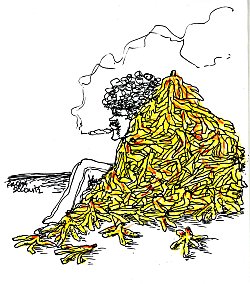
The electric Country Joe and The Fish band played in Vancouver, British Columbia, Canada, many times starting about 1967 and ending in 1969. We mostly as I remember it played at the Kitsilano Theater in the Kitsilano District. That was where most of the hippies lived. They had an underground newspaper called the Georgia Straight named after a body of water. I remember some of the local bands, Painted Ship and United Empire Loyalists. Chicken told me on a plane ride up to Canada that he had figured out that banana peels could get you high. He said that the peelings had the same stuff as marijuana in them. This was not true at all. The banana does have something in it, tryptophan I think, that does produce a mild feeling of calmness and relaxation. Maybe Gary had read about that, I don’t know. But he said if we dried out the peelings and scrapped off the white stuff and rolled it up and smoked it, it would get us high. We were living on peanut butter and banana sandwiches at the time and just throwing the peelings away, so this seemed like a good idea.
After the plane landed and we got to the theater and the roadies were loading in the equipment we went into the Psychedelic Shop across the street and told Linda about the banana thing and asked if we could use the oven in the back room to dry out the banana peels. She said sure. So we went up on the corner to the little mom and pop store and got a bunch of bananas and brought them back into the back room. We peeled the bananas, ate the bananas and put the peelings in the oven at a very low temperature, so as not to destroy the THC in the banana peels. Then we went across the street to the theater to do our sound check.
The stage crew told us, "You see that water jar over there on the side of the stage? We just dissolved a bunch of LSD in it. If you want some during the night just help yourself." So we went over and took a few sips off the water jar. Then we did our sound check. Then we went back across the street over to the Psychedelic Shop into the back room to see how the banana peels were doing.
Well they were much too damp to smoke so we just sat around talking until the roadies came and told us it was time for our first set. So we went across the street to the Kitsilano Theater. Went up on stage. Took another couple of sips from the water jar and played our first set. Then we went back across the street and into the back room again to check on the banana peels. We decided that they were dry enough to smoke, so we scrapped off a bunch of that white stuff. We went up front in the shop and asked Linda for some rolling papers. Got em. Came back into the back room and rolled up a bunch of banana joints.
We lit them up and started smoking them looking at each other and asking, "are you getting high?" "I don’t know how about you?". We must have smoked about twenty of those banana joints. Then the roadies came and told us it was time for the last set. So we stopped smoking and went across the street and into the theater to play our set. But before we started we took a few more sips from the water jar.
That night for our last set we started with "Not So Sweet Martha Lorraine" but just could not seem to stop playing it. We played a forty-five minute version of that song that night to our amazement. After the set we ran across the street to the Psychedelic Shop and into the back room and started smoking those banana joints saying, "Man this shit really works, I am so high I can’t believe it."
So after we packed up the equipment we went to some parties in Vancouver that night told people "bananas get you high." They thought we were crazy.…
We went back home to Berkeley and right away played a concert at California Hall in San Francisco that was a benefit for NORMAL, the campaign to legalize marijuana in California. We passed out 500 banana joints to the audience that night and told them, "It’s banana, it gets you high."
Next day I went up on Telegraph Avenue in Berkeley with a pipe filled with banana yuck and made my friends smoke it. I told them all, "IT’S BANANA, IT GETS YOU HIGH"
The next morning I went to the Co-Op to get our breakfast and there were no bananas in the banana bin. So I went over to Safeway and there were no bananas there. You could not get a banana in Berkeley that day. On the way home I saw a copy of the San Francisco Chronicle with a three inch headline that said,

BANANA TURN ON, NEW HIPPY CRAZE
Then we forgot about it. Three months later I was reading in the Chronicle and way in the back I saw a small headline that said,

DEA SMOKES BANANA JOINT
It seems that the Drug Enforcement Agency in Washington DC had a joint smoking machine and they puffed a banana joint through it and found it did nothing. It came out zero. Then I remembered the jar of LSD water?! So I took the paper over to Chicken’s house and told him, "You told us banana gets you high but the DEA smoked banana and it does nothing. It was all that psychedelic water we drank that night that got us high." He said, "Forget about that. I figured out last night, if you smoke a cigarette through a bell pepper it gets you really stoned." Those were desperate days.
FOOD AND DRUG ADMINISTRATION
FOR RELEASE FRIDAY, MAY 26, 1967
Was it all a hippie hoax?
A laboratory apparaus "smoked" dried banana peels for more than three weeks and never did get high, the Food and Drug Administration reported today.
"The Bureau of Science has made an analysis of the smoke obtained from several recipes for dried banana peel and concentrated banana juice," the FDA said. "There were no detectable quantitieg of known hallucinogens in these materials."
The FDA began the laboratory test after its Bureau of Drug Abuse Control received reports that dried scrapings from banana peels were being smoked for their hallucinogenic effect.
The FDA's "smoklng machine" consisted of a series of tubes and retorts which trapped the smoke. The chemical components of the smoke were examined by ultraviolet and infrared spectrophotometric procedures.
Small amounts of known hallucinogens were introduced during some tests to determine whather the substances could be detected in the smoke. The added hallucinogens were recovered and identified. But none was found in the tests of banana peels alone.
And "Donovan," as a generation of flower-children knew him ... did not get away without telling your own Swamp correspondent "a true story'' on the side. It was Country Joe McDonald, Donovan confessed, who had tried smoking bananas. Donovan, who brought out the Mellow Yellow album on Columbia Records in 1967, said he had not known until several years ago that McDonald, best known as front man in Country Joe and the Fish, was only somewhat miffed about his fellow singer's success with the banana-bliss song because he himself had tried smoking peels before that jingle came out.

Mark Silva in the Chicago Tribune, March 29, 2007
See Joe rap about bananas on YouTube.

_____________________

Jimi Hendrix


    I first saw Jimi Hendrix at the 1967 Monterey Pop Festival. He performed with his trio The Jimi Hendrix Experience. This was held in June 1967 at the Monterey Fair Grounds in Monterey, California. It was and is quite an important musical event. I was almost in the front row of the audience with Jimi performed and found him quite entertaining and had the feeling that he would certainly be successful. A few weeks later, on July 1st Country Joe and The Fish performed with Jimi and The Experience and a few other groups at the Earl Warren Show-grounds, in Santa Barbara, California.
    I have always been plagued with hay fever and at this gig the promoter had put flowers all over the hall. I grew up in Southern California and that was where my allergy symptoms were the worst. I began to sneeze. It did not help to have fans come up with flowers and shove them in my face. This was the time of hippy flower power so it made sense for the promoter to do this but it was terrible for me. I remember going up to Jimi in the dressing room to talk with him and not being able to do much of anything except say hi and sneeze. I was sneezing about ten times a minute. I took some allergy medicine and don’t remember any more of the event.
    It was not long after that the Jimi died. It was September 18, 1970 in London. I had just seen him perform at Woodstock. I came early to Woodstock to see as many acts as I could and was there in front of the stage when he performed as the last act of the festival. I remember watching him and thinking that I did not like his new group or what he was playing. But when he performed the Star Spangled Banner I was astounded. I thought that he was the finest electric guitar player I had ever heard and that he was a genius. I thought he was like a great jazz player, much more that any rock player I had ever heard. And then a month later he was dead.
    Years and years later I did a little tour solo in Italy. The promoter and guide was Ezio Guaitamacchi a very well known writer and performer and editor of a music magazine. He took me to a man known as Red Ronnie’s house for an interview. At lunch Red Ronnie told me that he had bid on Jimi Hendrix guitar on auction and bought it and then sold it. He also told me some wild story about photos of Jimi Hendrix he had some how got and he brought them out to the table. They were pictures of Jimi naked in bed looking very stoned with two naked women. He had about a dozen of them. I asked him what he was going to do with them. He said he was waiting for Jimi to tell him. Then we left his house and I never saw Red Ronnie again.